
Brief
Learn how permafrost foundation design protects buildings in Arctic regions through piles, thermosyphons, drainage and climate-resilient engineering
Overview
Constructing buildings in Arctic and subarctic regions requires specialised engineering because the stability of a permafrost foundation depends on preserving permanently frozen ground. When permafrost thaws, the soil can lose strength, settle unevenly and jeopardise the safety and service life of buildings, roads and other infrastructure. Consequently, successful permafrost foundation design focuses on minimising heat transfer into the ground while allowing the foundation system to adapt to changing environmental conditions.
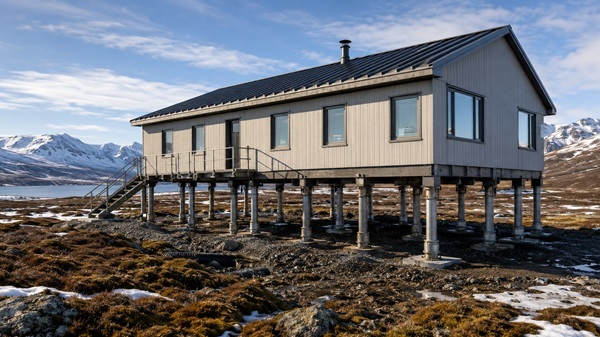
One of the most widely used solutions is the installation of pile foundations. Steel, concrete or timber piles transfer structural loads into stable frozen soil while elevating the building above the ground surface. The resulting air gap promotes natural ventilation beneath the structure, reducing heat accumulation and helping to maintain frozen ground conditions. Where bedrock is too deep to be economically reached, adfreeze piles provide an effective alternative by developing their load-bearing capacity through a frozen bond with the surrounding soil.
Another practical solution is the use of post-and-pad foundations. These systems typically consist of gravel pads supporting timber, steel or concrete posts fitted with adjustable brackets. Their relatively simple construction and ease of adjustment make them well suited to remote northern communities where access, transportation and maintenance present significant challenges.
Modern permafrost foundation design also incorporates thermosyphons in locations where additional thermal protection is required. These passive heat-transfer devices remove heat from the ground during cold weather without requiring external power, helping preserve frozen soil beneath critical infrastructure such as pipelines, buildings and transportation facilities.
Selecting an appropriate construction site remains equally important. Engineers seek locations with stable permafrost, minimal ground ice and favourable drainage conditions. Maintaining existing vegetation wherever practical helps preserve the natural insulation provided by mosses and shrubs, while effective drainage systems prevent water accumulation that could accelerate thawing around foundations. Construction activities are also often scheduled during the coldest months to minimise disturbance to frozen ground.
As Arctic temperatures continue to rise, climate resilience has become an increasingly important consideration. Adjustable foundation systems equipped with levelling mechanisms allow engineers to compensate for gradual settlement without extensive reconstruction. Continuous monitoring of ground temperatures, active layer thickness and foundation performance also enables early detection of changes that may affect long-term stability.
Remote construction projects additionally benefit from lightweight materials, modular construction techniques and careful logistical planning to reduce transportation costs and minimise environmental disturbance. Incorporating local knowledge of snow accumulation, seasonal drainage patterns and ground behaviour further improves engineering decisions and enhances long-term performance.
For engineers working in cold regions, understanding permafrost foundation behaviour is essential for delivering safe, durable and sustainable infrastructure. By combining sound geotechnical investigation, appropriate permafrost foundation design, effective site preparation, climate adaptation strategies and ongoing monitoring, construction projects can achieve reliable long-term performance despite increasingly challenging environmental conditions.
Key Takeaways
- Pile-supported foundations, post-and-pad systems and thermosyphons minimise heat transfer, helping preserve permafrost and maintain long-term structural stability in Arctic construction.
- Arctic warming is reducing permafrost bearing capacity, making adjustable foundation systems and continuous ground monitoring increasingly important for resilient infrastructure.
- Effective site selection, drainage control and construction timing are essential to limit permafrost thaw and reduce long-term foundation settlement.
READ MORE
Engineering Context
1. Permafrost as an Engineering Ground Condition
Permafrost is ground that remains at or below 0°C for at least two consecutive years. It may comprise soil, rock, sediment and varying quantities of ground ice. From a foundation-engineering perspective, the presence, distribution and thermal stability of ice can be as significant as conventional soil parameters because changes in ground temperature can alter both deformation and load-bearing behaviour.
The upper portion of permafrost terrain commonly includes an active layer that freezes and thaws seasonally. Beneath it, permanently frozen ground may provide relatively stable support while it remains frozen. The engineering challenge is therefore unusual: construction must not only accommodate the existing geotechnical conditions but also consider how the structure itself and future environmental conditions may modify them.
A foundation that performs adequately at completion may become vulnerable if its thermal interaction with the ground is not properly understood.
2. Why Thaw Can Threaten Foundation Performance
Frozen ground does not respond uniformly to warming. The consequences depend strongly on soil type, ice content, drainage, temperature and stress conditions.
Ice-rich permafrost can be particularly sensitive. When ground ice melts, the resulting water occupies less volume than the original ice and previously ice-bonded soil may lose stiffness and strength. Consolidation and rearrangement of the soil structure can then produce thaw settlement. Where ice content or thermal conditions vary across a site, settlement may be differential.
For structures and infrastructure, differential movement is often more damaging than uniform settlement because it can distort structural frames, floors, façades, services, pipelines and transport surfaces.
Cold-region foundation engineering must also consider the opposite seasonal mechanism: frost heave. Where frost-susceptible soil, sufficiently low temperatures and available water occur together, ice lenses can develop and cause upward ground movement. Foundations may therefore be exposed to combinations of thaw settlement, frost heave and seasonal movement rather than a single geotechnical hazard.
3. The Foundation and Ground Form a Thermal System
Conventional foundation design is commonly dominated by questions of bearing resistance, settlement, structural capacity and groundwater. Permafrost engineering adds another fundamental consideration: heat transfer.
Heat may enter the ground from heated buildings, buried services, solar radiation, altered surface conditions and construction activities. Removing vegetation, disturbing the organic surface layer, changing drainage or placing heat-absorbing materials can alter the pre-construction thermal regime.
This means foundation performance cannot be considered independently from the building and its surroundings.
A successful solution may involve separating heated accommodation from the ground, insulating foundations or floors, providing ventilated spaces, controlling drainage, using passive cooling or combining several measures. The appropriate strategy depends on the thermal and geotechnical characteristics of the site rather than on a universally preferred foundation type.
The governing relationship is therefore:
Structure ↔ Foundation ↔ Ground ↔ Thermal Environment
A change in any part of this system can influence the others.
4. Foundation Strategies and Their Engineering Logic
Pile foundations are widely applicable where loads need to be transferred below unstable near-surface material into ground capable of providing the required support. In permafrost, pile behaviour may involve end bearing, shaft resistance or adhesion to frozen soil, depending on the ground profile and design approach.
Adfreeze piles specifically rely substantially on the bond developed between the pile and surrounding frozen ground. Their capacity is therefore linked to the maintenance of suitable frozen conditions. Warming of the surrounding permafrost can reduce the reliability of a design that depends upon this mechanism.
Elevated construction can provide an additional thermal benefit by allowing cold air to circulate beneath a building and reducing direct heat transfer from occupied spaces into the ground.
Other structures may use shallow, adjustable or pad-supported systems where ground conditions, loads and anticipated movements permit them. Adjustability can provide a means of correcting some differential movement during service, but it should not be regarded as a substitute for controlling the underlying geotechnical and thermal risks.
The appropriate foundation is consequently selected from an assessment of ground conditions, structural demand, thermal behaviour, constructability, maintenance requirements and expected future conditions.
5. Thermal Control as Part of Foundation Engineering
Where passive separation and insulation are insufficient, additional ground-temperature management may be required.
Thermosyphons are one established approach.
These sealed passive heat-transfer systems use temperature differences between the ground and atmosphere to extract heat from the ground when external conditions are sufficiently cold. Because their operation depends on favourable temperature gradients, their performance is inherently connected to climate conditions and system design.
Thermosyphons demonstrate a broader engineering principle: ground temperature can become a design variable rather than merely an environmental condition. However, thermal-control measures must be evaluated as parts of the complete foundation system. Their effectiveness depends on factors including thermal loads, ground properties, installation configuration, climate, surface conditions and long-term performance.
6. Site Investigation Must Characterise More Than Soil Strength
A conventional description of soil type and strength is insufficient for many permafrost projects. Investigation needs to establish the characteristics that control both mechanical and thermal behaviour.
Relevant information can include permafrost distribution and continuity, ground temperatures, active-layer thickness, soil stratigraphy, ground-ice occurrence and content, groundwater and drainage conditions, frost susceptibility and evidence of existing thermokarst or ground movement.
Spatial variability deserves particular attention. Two investigation points separated by a relatively short distance may encounter substantially different ice conditions, creating different settlement potential if thaw occurs. Investigation should therefore support a ground model that describes not only what is present, but how the ground may respond to construction, heat input and environmental change.
7. Climate Change Alters the Design Problem
Permafrost foundation design has traditionally sought to understand and preserve an existing frozen-ground regime. In many locations, long-term warming means that assuming historical ground temperatures will remain unchanged may no longer be sufficiently robust. Climate resilience therefore requires consideration of how ground temperature, active-layer depth and permafrost condition could evolve during the intended service life.
This does not mean that every site will experience the same degree of degradation. Permafrost response varies substantially with climate, ground ice, vegetation, snow cover, hydrology, terrain and local disturbance. Design assumptions should consequently be based on appropriate site-specific evidence and credible future conditions rather than broad regional generalisations.
The professional question shifts from:
“Is the ground suitable now?”
to:
“Can the foundation system maintain acceptable performance as the ground conditions evolve?”
8. Construction Can Change the Conditions Being Designed For
Construction activity itself can disturb permafrost. Excavation, removal of insulating vegetation, alteration of snow accumulation, changes to surface drainage, equipment traffic and placement of new materials can modify heat and water flows. Poorly controlled construction may therefore create ground conditions different from those assumed during design.
Construction planning should minimise unnecessary disturbance and maintain the thermal and drainage measures upon which the design depends. Remote locations add further constraints because equipment, materials, labour and repair capability may be difficult or expensive to mobilise.
Prefabrication and modular construction can reduce some site activities and logistical demands, but their suitability remains project-specific. Constructability in cold regions must be considered alongside structural and thermal performance from the beginning of design.
8. Monitoring Closes the Design–Performance Loop
Where foundation performance depends strongly on maintaining particular thermal conditions, monitoring can provide evidence of whether design assumptions remain valid.
Instrumentation may be used to observe ground temperatures, active-layer behaviour, foundation movement or structural response. The appropriate monitoring regime depends on the consequence of failure, uncertainty in predicted conditions and sensitivity of the foundation system.
Monitoring has greatest value when linked to predetermined interpretation and response criteria. Collecting temperature or movement data without defining how trends will be evaluated provides limited risk control.
A robust approach connects:
Prediction → Measurement → Interpretation → Intervention
If observations indicate unexpected warming or movement, engineers can investigate the cause and determine whether drainage improvements, thermal measures, foundation adjustment, structural intervention or other action is justified.
9. Practical Framework for Permafrost Foundation Decisions
When assessing a proposed foundation in permafrost terrain, professionals can consider six connected questions:
9.1. Ground condition: What permafrost, ground ice, active-layer, groundwater and soil conditions actually exist across the site?
9.2. Thermal interaction: How will the completed structure, services, surface treatment and construction process alter the ground-temperature regime?
9.3. Ground response: What settlement, heave or loss of foundation resistance could occur if temperatures or moisture conditions change?
9.4. Foundation strategy: Can the selected system safely accommodate or control the predicted mechanical and thermal behaviour?
9.5. Future resilience: Does the assessment consider credible changes during the intended service life rather than relying only on present conditions?
9.6. Verification and response: How will performance be monitored, and what actions are available if behaviour departs from predictions?
These questions move foundation selection away from choosing a particular foundation type and towards managing the long-term interaction between structure, ground and climate.
10. Professional Takeaway
Permafrost foundation engineering is fundamentally an exercise in managing coupled geotechnical and thermal behaviour. Structural capacity at the time of construction is only one part of the problem. Engineers must understand how heat, water, ground ice, construction disturbance and environmental change can modify the supporting ground throughout the service life.
The transferable principle is:
Characterise → Predict → Protect →
Accommodate → Monitor → Respond
A resilient solution does not depend solely on preventing change. It combines reasonable control of ground conditions with sufficient capacity to recognise and manage changes that cannot confidently be prevented.
11. Engineering Mindset
In temperature-sensitive ground, the environment is part of the foundation system.
Engineers should therefore avoid treating the ground conditions recorded during investigation as permanently fixed properties. The stronger approach is to understand what controls those conditions, determine how construction and future environmental change could alter them, and design both the foundation and its verification strategy around credible behaviour over time.
The central professional question is not simply whether a foundation works under today’s ground conditions, but whether its performance remains acceptable as those conditions evolve.
Related Questions:
- * How to build a foundation on permafrost?
- * What are the challenges of building on permafrost?
- * What are the 4 types of permafrost?
Related Media:



Recent Comments