
Brief
Explore how permeable pavement helps municipalities manage stormwater, reduce flooding and erosion, support groundwater recharge, and protect local streams.
Overview
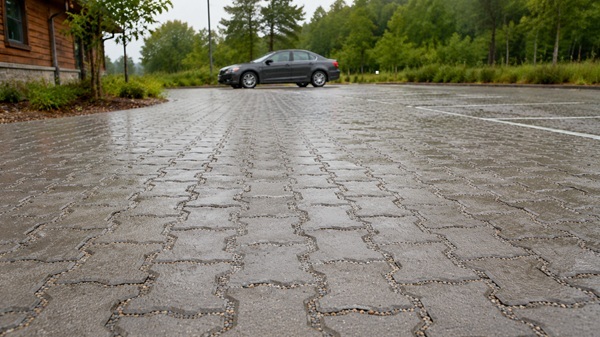
Permeable pavement is designed to support vehicles and pedestrians while allowing rainwater to pass through the surface and infiltrate the underlying soil. It may consist of concrete blocks with open joints, recycled-plastic grids filled with aggregate, or porous concrete manufactured without sand. By enabling infiltration, these systems help maintain groundwater recharge and stream base flow while reducing surface runoff.
Municipalities increasingly use permeable pavement as part of their stormwater-management strategies. Projects in Westmoreland County, Pennsylvania, have incorporated permeable parking areas and walkways to reduce flooding, erosion, sedimentation and pollutant discharge into local waterways. Such measures may also support compliance with stormwater-management requirements and, in some communities, influence the reassessment of stormwater fees.
However, permeable pavement is not suitable for every location. It generally performs best on relatively flat land and in lower-traffic areas. Steep slopes can cause water to collect downhill rather than infiltrate evenly, while heavy traffic may damage the comparatively weaker surface. Sediment and pollutants can also clog its pores, making appropriate site selection, design and ongoing maintenance essential.
Key Takeaways
- Permeable pavement supports traffic while allowing rainwater to infiltrate the underlying soil.
- Common systems include permeable concrete pavers, aggregate-filled plastic grids and porous concrete.
- It is most suitable for relatively flat, lower-traffic areas and requires maintenance to prevent clogging by sediment and pollutants.
READ MORE
Engineering Context
1. From Traffic Surface to Water-Management System
Permeable pavement is a load-bearing pavement system designed to admit rainfall through its surface and temporarily store, convey or infiltrate the water within the underlying construction. Common forms include permeable concrete block paving, porous asphalt, pervious concrete and reinforced gravel or grass systems.
Its engineering purpose extends beyond replacing an impermeable surface. A complete system must perform two functions simultaneously: provide an adequate surface for its intended traffic and manage water at an acceptable rate and volume. Successful performance therefore depends on the interaction between the surface, jointing or pore structure, bedding and sub-base materials, geotextiles where used, underlying ground, drainage arrangements and maintenance regime.
This distinction matters because a permeable surfacing material does not, by itself, create an effective sustainable drainage system. Water may pass through the surface yet fail to infiltrate the ground, or the pavement may manage rainfall hydraulically while proving unsuitable for the imposed loading. Performance must be considered at system level.
2. Why Permeable Pavement Is Used
Conventional impermeable development interrupts the natural movement of rainfall into the ground. Water is collected rapidly from roofs, roads and hardstandings and discharged through drainage networks. This can increase runoff rates and volumes, place pressure on downstream infrastructure and contribute to erosion, pollution transport and flood risk.
Permeable pavement addresses this problem near the point where rain falls. Water enters through open joints or interconnected voids and passes into a permeable sub-base, which can provide temporary storage. Depending on the site and design, the stored water may:
- infiltrate into the underlying soil;
- infiltrate partially, with surplus water collected by an underdrain; or
- be contained and discharged at a controlled rate where infiltration is unsuitable.
The technique can therefore support the principles of sustainable drainage systems by controlling runoff closer to its source. Where ground conditions allow infiltration, it may also contribute to groundwater recharge. These outcomes are site-dependent, however, and should not be assumed without investigation and hydraulic assessment.
3. Hydraulic Behaviour and Water Quality
The hydraulic performance of permeable pavement depends on three related processes:
surface entry, storage and discharge.
First, rainfall must enter the pavement faster than it accumulates on the surface. The relevant entry mechanism varies by pavement type. Water may pass through open joints filled with permeable aggregate, through interconnected pores in a bound material or through the voids of a cellular grid.
Second, the pavement construction must provide sufficient void space to accommodate the design rainfall event. Storage capacity is influenced by the thickness, grading and void ratio of the sub-base, together with any water already present.
Third, stored water must leave the system at an appropriate rate. On freely draining ground, this may occur through infiltration. Where the subgrade has limited permeability, groundwater constraints exist or contamination risks must be controlled, an underdrain or lined construction may be required.
Permeable pavement can also assist water-quality management. Sedimentation, filtration, adsorption and biological processes within the pavement layers may reduce certain pollutants before discharge. The degree of treatment varies with pavement configuration, pollutant type, hydraulic loading, maintenance and environmental conditions. It should therefore be treated as a designed treatment function rather than an automatic consequence of using a permeable surface.
4. Ground Conditions and Site Suitability
Site assessment should precede selection of the pavement type. Soil permeability is an obvious consideration, but it is not the only one. Professionals should also evaluate groundwater level, ground stability, contamination, topography, nearby structures, buried services, drainage pathways and the consequences of exceedance.
Infiltration may be inappropriate where it could mobilise contaminants, adversely affect foundations, destabilise slopes or introduce water into sensitive ground. High groundwater can reduce available storage and limit infiltration. Steep sites may cause water to migrate within the pavement layers, producing uneven storage, local saturation or uncontrolled emergence downslope.
Where direct infiltration is unsuitable, permeable pavement may still be viable as a lined or partially infiltrating system. The design question is therefore not simply whether the soil drains freely, but how water should safely enter, remain within and leave the pavement system.
5. Structural Performance and Use
The pavement must resist the expected loading throughout its service life while retaining its hydraulic function. Traffic volume, axle loading, turning movements, braking forces and the likelihood of concentrated or construction loads all influence suitability.
Lower-traffic applications such as parking areas, pedestrian routes, private drives and lightly trafficked access roads are common uses. Heavier or more demanding applications may be possible, but require project-specific structural design, suitable materials and careful detailing. Frequent heavy turning or braking can be particularly demanding on certain unit-based or cellular systems.
The sub-base performs both structural and hydraulic roles. Its grading must provide load distribution and adequate void space without becoming unstable under traffic. The subgrade must also be assessed for bearing capacity and sensitivity to water. A design that maximises storage without providing sufficient mechanical stability is no more successful than a structurally robust pavement that rapidly clogs or cannot manage the required rainfall.
6. Clogging, Construction and Maintenance
Clogging is one of the principal threats to long-term hydraulic performance. Fine sediment, organic matter and construction debris can obstruct surface pores or permeable joints. Runoff from unprotected soil, landscaped areas or adjacent conventional surfaces may introduce sediment faster than the pavement can retain it without loss of function.
This risk begins during construction. A permeable pavement should not be used as an uncontrolled route for mud-laden site traffic or as a sediment-management area. The subgrade and pavement layers require protection from contamination, and specified aggregates should not be substituted with materials containing excessive fines.
After completion, maintenance should respond to the system type and observed condition. It may include sweeping, vacuum cleaning, removal of accumulated sediment, vegetation management and reinstatement of jointing aggregate. Maintenance access, responsibilities and methods should be established during design rather than considered only after performance declines.
Clogging does not necessarily produce immediate structural failure. The first visible sign may instead be persistent ponding or slower drainage. Inspection must therefore address hydraulic behaviour as well as surface condition.
7. Design Trade-offs and Interfaces
Permeable pavement requires coordination across highways, drainage, landscape, geotechnical and environmental disciplines. Decisions made in one area can alter performance elsewhere.
A highly permeable surface cannot compensate for inadequate storage or discharge capacity. Greater storage depth may affect excavation, utilities, cost and groundwater separation. Introducing an impermeable liner may protect sensitive ground but remove groundwater-recharge benefits. Landscaping can improve the development but may also become a sediment source. Winter maintenance, accessibility, surface evenness, material availability and reinstatement following utility works can also affect whole-life suitability.
Cost comparisons should include more than the surfacing rate. Permeable pavement may reduce or alter the need for gullies, pipes, attenuation structures and downstream drainage works, but it may require specialist materials, tighter construction control and planned maintenance. The appropriate comparison is between complete systems delivering equivalent structural, hydraulic and environmental requirements.
8. Practical Framework for Professional Decisions
A defensible assessment can be organised around six questions:
8.1. What must the pavement support?
Establish users, traffic categories, loading, manoeuvres, accessibility needs and required service life.
8.2. What rainfall must the system manage?
Define the relevant rainfall events, contributing catchment, allowable discharge and acceptable exceedance behaviour.
8.3. Where will the water go?
Confirm whether the system will infiltrate, partially infiltrate or discharge through a controlled outlet.
8.4. What site conditions govern the design?
Investigate subgrade strength, infiltration characteristics, groundwater, contamination, levels, slopes, structures and services.
8.5. How will hydraulic capacity be protected?
Control sediment sources, specify compatible materials, protect the works during construction and provide an achievable maintenance plan.
8.6. How will performance be verified?
Inspect materials and layer construction, confirm levels and outlets, document any testing required by the project and monitor for ponding, clogging, settlement or surface deterioration in service.
9. Professional Takeaway
Permeable pavement should be selected and designed as infrastructure, not decorative surfacing. Its value depends on aligning structural demand, rainfall response, ground conditions, water-quality objectives, construction control and maintenance capability. The transferable reasoning sequence is:
Define performance → Understand the site →
Design the system → Protect construction → Verify operation
10. Engineering Mindset
Do not equate permeability with suitability. Begin with the required structural and drainage outcomes, trace how water and loads will move through the complete pavement, and test every assumption against site conditions and whole-life operation. A permeable surface becomes an engineering solution only when its entry, storage, discharge and maintenance functions work together.
Related Questions:
- What are the downsides of permeable paving?
- How expensive is permeable paving?
- What is classed as permeable paving?
Related Media:
Related Publications:


Recent Comments