
Brief
Discover how the Hoover Dam concrete cooling system controlled heat of hydration using staged pours, embedded pipes and chilled water.
Overview
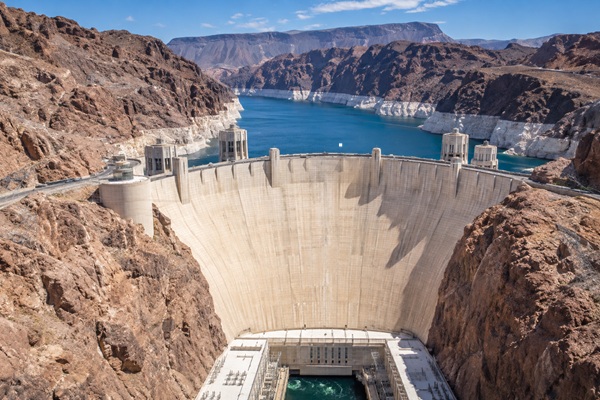
The Hoover Dam concrete cooling system was a critical engineering solution to one of the greatest challenges in mass concrete construction: controlling the heat of hydration. Without measures to manage this heat, engineers calculated that a single continuous mass of concrete could have taken around 125 years to cool to the surrounding air temperature. The resulting temperature differences and associated stresses could have caused severe cracking.
Instead of constructing the dam as one continuous concrete mass, engineers divided it into individual trapezoidal columns built in five-foot lifts. Concrete placement in each block was limited to five feet within 72 hours, helping control the rate at which heat accumulated. The blocks also incorporated keyed joints that would later help connect the separate sections into a unified structure.
Cooling was accelerated through an extensive network of embedded one-inch steel pipes, with more than 582 miles of pipe installed throughout the concrete. The process operated in two stages. River water was first circulated through the cooling coils, followed by chilled water supplied by a refrigeration plant capable of producing the equivalent of 1,000 tons of ice every 24 hours.
Once individual blocks had cooled, contraction created spaces between adjacent columns. The cooling pipes were then cut off and pressure-grouted, while cement and water grout was injected into the spaces between the columns. Combined with the keyed joints, this process bonded the separate blocks into a monolithic structure.
The Hoover Dam concrete cooling system therefore combined controlled concrete placement, internal pipe cooling and subsequent grouting to manage the thermal effects of mass concrete construction. Reclamation records indicate that the dam’s cooling programme was completed in March 1935, demonstrating how deliberate thermal management formed an integral part of constructing the massive concrete structure.
Key Takeaways
- Engineers constructed the dam as separate concrete columns built progressively in five-foot lifts.
- More than 582 miles of embedded steel pipe formed an internal cooling network throughout the concrete.
- River water provided initial cooling before chilled water circulated through the same embedded cooling coils.
- After cooling, cement-and-water grout filled contraction gaps between columns, helping bond the separate blocks into a monolithic structure.
READ MORE
Engineering Context
Mass concrete behaves differently from smaller concrete elements because its dimensions can restrict the dissipation of heat generated during cement hydration. Hydration is an exothermic chemical process: as cement reacts with water, heat is released. In relatively thin elements, much of this heat can dissipate through exposed surfaces. In large sections, however, heat generated within the interior may escape much more slowly.
The engineering concern is not simply that concrete becomes warm. The more significant issue is the development of temperature differences within the element and the restraint of the resulting thermal movement. The interior may remain relatively hot while surfaces cool more rapidly. As temperatures change, different parts of the concrete tend to expand or contract by different amounts. Where this movement is restrained, tensile stresses can develop.
If those tensile stresses exceed the concrete’s tensile capacity at the relevant age, cracking can occur. Thermal control in mass concrete is therefore fundamentally a matter of managing temperature development, temperature gradients, restraint and the evolving properties of the concrete.
1.Understanding the Thermal Behaviour
The thermal behaviour of mass concrete is governed by interacting factors rather than by heat of hydration alone. The cementitious system influences how much heat is generated and how quickly it develops. Concrete proportions, placing temperature, element dimensions and geometry also affect the temperature history. At the same time, ambient conditions, formwork, insulation and exposed surface conditions influence the rate at which heat leaves the concrete.
Concrete properties are changing throughout this process. Early-age concrete initially has limited strength and stiffness, while hydration progressively develops its mechanical properties. This means that thermal movement, restraint and strength development are occurring simultaneously.
A useful engineering reasoning chain is:
Heat generation → Temperature distribution →
Restrained movement → Tensile stress → Cracking risk
This explains why a single maximum temperature cannot, by itself, describe the complete thermal risk. Professionals need to consider how temperatures vary spatially and over time, how rapidly cooling occurs and how strongly movement is restrained.
3. Sources of Restraint and Thermal Cracking
Restraint may arise internally or externally.
Internal restraint develops when different regions within a concrete element experience different temperature changes. A cooler surface and warmer core, for example, do not naturally undergo identical thermal movement. External restraint occurs when the concrete’s movement is restricted by adjoining structural elements, foundations, previously hardened concrete or other boundary conditions. The significance of restraint therefore depends on the structural arrangement as well as the concrete itself.
Cracking risk is consequently a system-level problem. Changing the concrete mixture may influence heat generation, but this does not automatically resolve problems created by geometry, placing sequence, boundary restraint or rapid surface cooling. Effective thermal management considers these influences together.
4. Thermal Control Strategies
Thermal control aims to influence the temperature history and resulting stresses rather than relying on a single corrective measure. One approach is to control the concrete temperature at placement. Another is to manage the rate and sequence of construction so that excessive heat does not accumulate within very large placements. Mix design can also influence heat development, although any modification must remain compatible with the required strength, durability, workability and construction performance.
Surface protection and insulation may be used to manage the rate at which exposed concrete loses heat. This can appear counter-intuitive because insulation retains heat, but reducing rapid surface cooling can help limit steep temperature differences between the interior and exterior.
For particularly demanding mass concrete applications, embedded cooling pipes can provide active internal temperature control. Water circulated through these pipes removes heat from within the concrete rather than relying solely on natural heat transfer through the surfaces.
The appropriate solution is project-dependent. Measures that are suitable for one foundation, retaining structure or large structural element may not be appropriate for another because geometry, materials, restraint, climate and construction sequence differ.
5. Planning Thermal Performance Before Placement
Thermal management is most effective when treated as part of design and construction planning rather than as a response to unexpected temperatures after placement.
Professionals should first establish the required concrete performance and understand the geometry and restraint conditions of the element. The likely heat development and temperature distribution can then be considered alongside the proposed mix, initial concrete temperature, placement size and sequence, environmental conditions and curing arrangements.
For more demanding applications, thermal analysis or modelling can help evaluate expected temperature histories and compare alternative control strategies. Such modelling should support engineering judgement rather than replace it. Its usefulness depends on the assumptions and material properties used to represent actual project conditions.
Construction planning must also remain realistic. A theoretically effective thermal-control strategy has limited value if the required concrete temperatures, placing sequence, insulation arrangements or monitoring provisions cannot be achieved consistently on site.
6. Monitoring and Verification
A thermal-control plan should include a means of determining whether actual concrete behaviour is consistent with the intended strategy. Temperature monitoring can provide information about how the concrete heats and cools after placement. Measurements at appropriate locations can help identify internal temperature development and temperature differences within the element.
Monitoring is not merely a record-keeping exercise. Results need to be interpreted against the project’s thermal-control criteria and expected behaviour. Unexpected temperature development may indicate that assumptions about materials, environmental exposure, construction sequence or heat dissipation require review.
Verification therefore closes the engineering loop:
Predict → Control → Monitor → Compare → Respond
The value of monitoring lies in connecting measured conditions to decisions.
7. Practical Framework for Mass Concrete Decisions
A practical assessment can be organised around six questions:
7.1. What level and rate of heat generation can reasonably be expected from the proposed concrete?
7.2. How will the element’s dimensions and geometry affect heat dissipation?
7.3. Where could internal or external restraint convert thermal movement into tensile stress?
7.4. Which combination of mix design, placing temperature, construction sequence, insulation or active cooling is appropriate?
7.5. How will the proposed measures be implemented consistently under actual site conditions?
7.6. How will temperatures and thermal performance be monitored and assessed after placement?
These questions encourage professionals to examine the complete thermal system rather than focusing on one material property or control technique.
8. Balancing Competing Requirements
Thermal control involves trade-offs. Reducing heat generation may be desirable, but concrete must still achieve the specified structural and durability performance. Limiting placement size may improve thermal control while affecting programme, joints, temporary works and construction logistics. Insulation may reduce harmful temperature gradients but can also influence the overall cooling period. Active cooling can provide greater control but introduces additional design, installation, operation and verification requirements.
The objective is therefore not simply to minimise concrete temperature. It is to manage the temperature history and associated restraint so that the risk of unacceptable thermal cracking is controlled while the wider performance and construction requirements remain satisfied.
9. Professional Takeaway
Heat of hydration becomes an engineering problem when the resulting temperature changes interact with geometry, heat dissipation and restraint. Thermal control should therefore be approached as a coordinated performance problem rather than as an isolated concrete-temperature issue.
A transferable decision sequence is:
Anticipate heat → Assess restraint →
Control temperature development Monitor behaviour → Verify performance
This reasoning applies beyond any particular dam or project and provides a useful basis for evaluating mass concrete foundations, thick structural elements and other large concrete placements.
10. Engineering Mindset
Mass concrete should be assessed as a changing thermal and structural system. A capable professional does not ask only how much heat the concrete will generate, but where that heat will go, how different parts of the structure will respond, what will restrain their movement and how actual behaviour will be verified. The appropriate intervention follows from understanding those interactions, not from applying a preferred cooling technique by default.
Related Questions:
- What is the heat of hydration of concrete?
- How did the Hoover Dam concrete cooling system control heat during construction?
- What thermal cracking risks can heat of hydration create in mass concrete?
Related Media:
Related Publications:



Recent Comments