
Brief
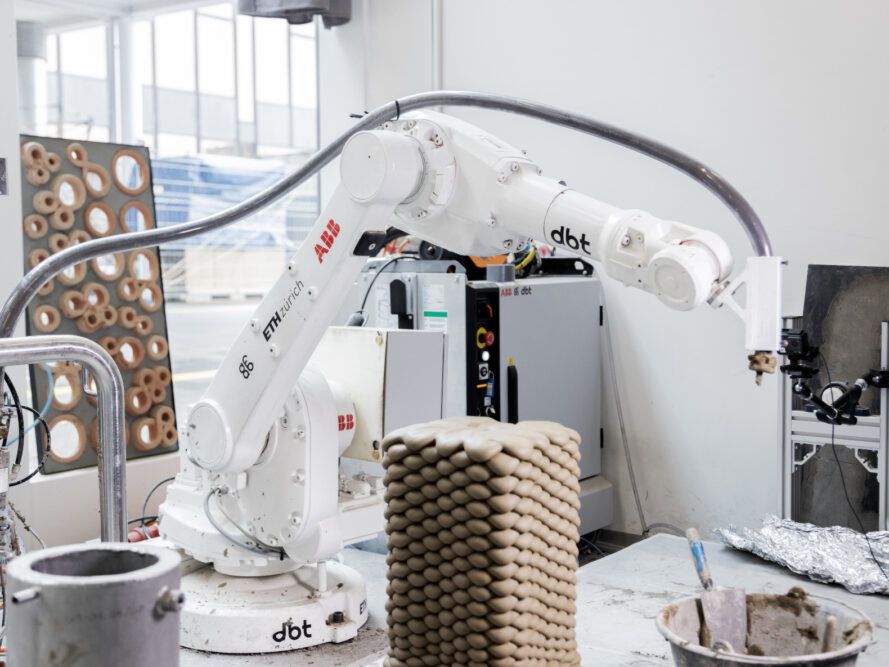
In an effort to cut down construction-related carbon emissions, researchers in the Digital Building Technologies (DBT) department at ETH Zürich have created FoamWork. The project examines how foam 3D printing (F3DP) can be used in conjunction with concrete casting. The outcome is a less labor-intensive system that enhances material efficiency and lowers carbon emissions.
Insight
A slab prototype by the DBT team shows how versatile it is to combine concrete structures and 3D-printed foam. The slab uses ribs derived from isostatic lines, which indicate the directions of compression and tension. Based on the principal stress pattern, the geometry of this slab has 24 cavities for foam inserts of 12 different shapes.
For the foam production, ETH Zürich has collaborated with FenX AG, a company that uses mineral waste to produce high-performance building insulation. A robotic arm fabricates the foam components using recycled fly ash, the waste from coal-fired power stations.
The foam components are arranged in timber formwork before poured in ultra-high-performance fiber-reinforced concrete (UHPFRC) to cast the structural element. Once the concrete cures, the foam pieces can either be left in for their insulative properties, or the raw material can be recycled and reprinted for other FoamWork projects.
This process can be replicated for other standardized or more intricate concrete structural elements. Calculating the principal stress patterns can be used to design and fabricate various material-efficient structural elements. These can range from standardized elements to customized slabs and walls.
READ MORE


Recent Comments