
Brief
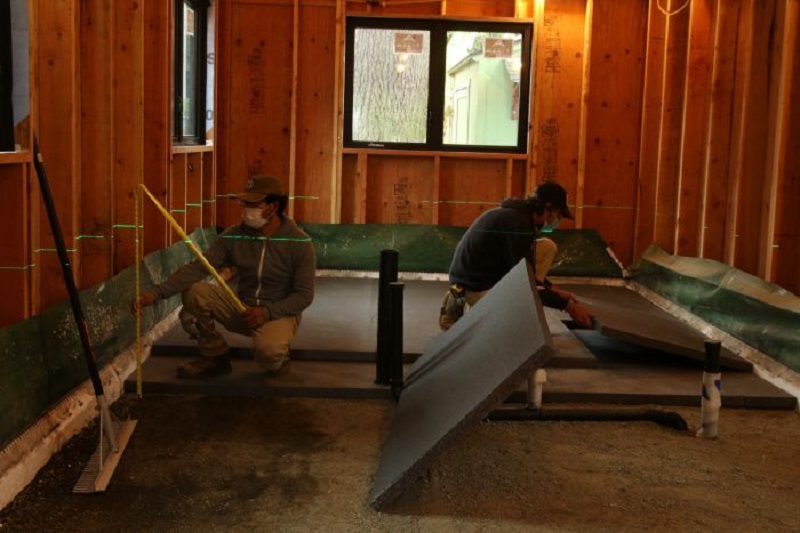
A plywood slab-on-grade requires a similar foundation construction to the ones used when building a traditional concrete slab-on-grade home.
Insight
There are several benefits to building a concrete-free, slab-on-grade home, including a reduction in embodied carbon, less flooring headaches, and faster completion times.
When choosing to build a home with a plywood slab, the foundation construction and insulation options are similar to the ones used when building a traditional concrete slab-on-grade home. At Birdsmouth Design Build, we build our foundations using insulated concrete forms (ICF), but if you would rather not use ICFs, here are two additional options.
1. Raise the insulation layer
If you’re okay with a step up into the home, you can simply raise the level of the horizontal insulation to be flush with the top of the stem wall (we also place a thin thermal break between the flooring and sill plate). This approach far and away exceeds minimum code requirements, but you’ll need to create a landing at the exterior door to avoid a short awkward step, and be sure to flash the threshold carefully to prevent water entry.
2. Place a vertical foam layer inside the stem wall
To bring the finished flooring down level with the threshold (in keeping with universal design) while creating the code-required thermal break at the edge of the slab, extend the continuous layer of foam under the slab into an L-shape at the edges. The downside here is a slightly larger space between the plywood slab and the flooring, making it difficult to attach flooring at the perimeter.
If you would like to learn more about the benefits of a concrete-free slab, or if you would like to see the detailed step-by-step process that will demonstrate exactly how to build one, check out the full story here.
READ MORE



Recent Comments