
Brief
How cross laminated timber CLT can support earthquake proof buildings design with lower carbon impact, controlled movement and faster recovery.
Overview
Cross laminated timber CLT is emerging as an important material in the future of resilient, low-carbon construction. As earthquake-prone regions seek safer and more sustainable building systems, engineered timber offers a practical route towards structures that are designed not only to protect lives during seismic events, but also to recover more quickly afterwards.
Unlike traditional timber framing, cross laminated timber CLT is manufactured from layers of timber boards bonded at right angles. This creates strong, stable panels that can be used for walls, floors and modular building components. Because timber stores carbon absorbed during tree growth, CLT can also help reduce embodied carbon when compared with conventional concrete and steel construction, provided it is responsibly sourced and correctly designed.
A key challenge in earthquake proof buildings design is managing movement. Major earthquakes generate strong horizontal forces, and buildings must be able to absorb, dissipate and accommodate this energy without suffering severe structural damage. Modern seismic design therefore goes beyond simply preventing collapse. It increasingly focuses on damage limitation, repairability and the ability of a building to return to service after an earthquake.
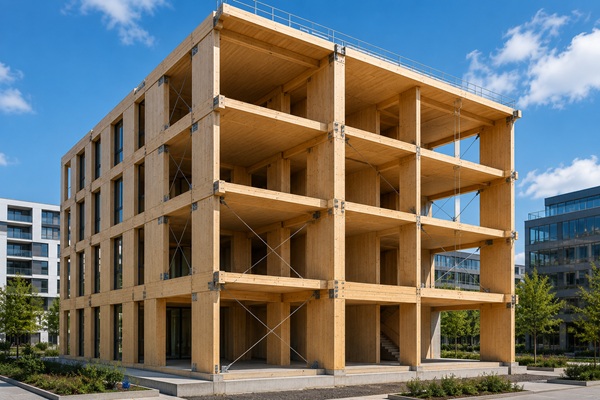
Recent full-scale testing of modular CLT structures has shown how controlled movement between storeys can improve seismic performance. Instead of forcing the building to behave as one rigid block, specially designed connection systems allow each level to move in a controlled manner. This helps reduce strain on the main timber structure and limits permanent deformation. In practical terms, this can support faster repair, lower reinstatement costs and reduced disruption for occupants.
One of the most valuable features of this approach is self-centring behaviour. After shaking stops, the building is designed to return close to its original position rather than remaining tilted or displaced. This is particularly important for medium-density housing, schools, offices and public buildings in seismic zones where post-earthquake usability matters.
However, cross laminated timber CLT is not a complete solution on its own. Non-structural elements, services, fire safety, moisture protection, connection detailing, long-term durability and code compliance must all be carefully assessed. Successful earthquake proof buildings design depends on the complete building system, not only the structural material.
Overall, CLT offers a promising combination of strength, sustainability, prefabrication efficiency and seismic resilience. With robust engineering, testing and quality control, it could help deliver a new generation of buildings that are safer, lower-carbon and quicker to recover after major earthquakes.
Key Takeaways
- A full-scale modular cross-laminated timber (CLT) building successfully withstood progressively stronger simulated earthquakes while its primary timber structure remained undamaged.
- The innovative self-centring connection system allowed storeys to move independently, dissipating seismic energy and returning the building to its original position after shaking.
- The tested CLT system could significantly reduce repair costs, downtime and post-earthquake disruption by minimising permanent structural damage and enabling faster reoccupation.
READ MORE
Engineering Context
1. From Life Safety to Seismic Resilience
Earthquake-resistant design has traditionally placed strong emphasis on preventing collapse and protecting life. Those objectives remain fundamental, but modern performance-based thinking increasingly considers what happens after the shaking stops. A building may remain standing yet still experience substantial residual deformation, damaged connections, impaired services or non-structural damage that makes repair difficult or occupation unsafe.
This distinction has encouraged greater attention to seismic resilience and low-damage structural systems. The objective is not to make a building immune to earthquakes, but to control where deformation and damage occur, limit permanent displacement and create a realistic path to inspection, repair and return to use.
Cross-laminated timber (CLT) provides one platform for developing such systems. Its usefulness, however, depends less on the timber panel in isolation than on how panels, connections, diaphragms and energy-dissipating components are configured as an integrated seismic system.
2. Understanding CLT as a Structural System
CLT consists of timber layers arranged with successive layers generally oriented perpendicular to one another and bonded to form large structural panels. The resulting elements can provide substantial in-plane and out-of-plane strength and stiffness and can serve as walls, floors and other structural components.
In seismic design, however, strong panels alone do not create a resilient building. The behaviour of the lateral-force-resisting system depends heavily on connections between panels and between walls, floors and foundations. Conventional connections may provide ductility and dissipate seismic energy through yielding or deformation, but this can leave damaged fasteners, connections or surrounding timber after a significant earthquake.
Low-damage systems approach the problem differently. Rather than relying primarily on distributed damage to accommodate earthquake-induced deformation, they seek to concentrate movement and energy dissipation in deliberately selected mechanisms or components.
3. Controlled Rocking and Self-Centring Behaviour
One important approach uses CLT walls that are permitted to rock in a controlled manner rather than remaining conventionally fixed against uplift at their bases. During lateral loading, controlled uplift and rotation can accommodate building movement while reducing damaging deformation within the principal wall panels.
Post-tensioning can provide a restoring force. As a wall rocks, the post-tensioning system develops forces that encourage it to return towards its original position when the lateral load diminishes. Supplementary devices, such as yielding steel components or friction-based connections, can provide energy dissipation.
These functions need to be distinguished. The CLT wall provides structural resistance; the rocking mechanism accommodates movement; restoring forces support self-centring; and designated devices may dissipate energy.
This separation of functions is important because self-centring alone is not equivalent to complete seismic performance. A system must achieve an appropriate balance between stiffness, strength, deformation capacity, energy dissipation and restoring capability.
4. Why Residual Drift Matters
Peak movement during an earthquake is only one measure of structural performance. Residual drift, the permanent lateral deformation remaining afterwards, can strongly influence whether a building can economically be repaired. A structure that survives without collapse but remains significantly displaced may require extensive intervention. In severe cases, technically possible repair may not be economically or practically justified.
Self-centring systems therefore target an important aspect of resilience: limiting residual deformation. Experimental and analytical research into post-tensioned and friction-based CLT systems has demonstrated the potential to reduce residual displacement and concentrate damage in components intended to accommodate or dissipate seismic action.
The broader engineering principle extends beyond timber construction: Good seismic performance concerns not only survival of the event, but the condition in which the structure emerges from it.
5. Design for Damage Control and Repairability
Low-damage design requires engineers to consider where damage is acceptable rather than assuming that all damage can be prevented. This can lead to a deliberate hierarchy in which selected components yield, slip or otherwise dissipate energy while more difficult-to-repair structural elements are protected. Where replaceable energy-dissipation devices are incorporated, post-earthquake intervention may potentially focus on inspection and replacement of those components rather than major structural reconstruction.
This strategy resembles the wider engineering principle of capacity design: undesirable or difficult-to-repair failure mechanisms are suppressed while predictable mechanisms are deliberately provided at controlled locations.
For CLT rocking systems, this requires careful detailing. Wall geometry, post-tensioning, base connections, wall-to-diaphragm connections, energy-dissipation devices and local stresses at rocking interfaces can all affect behaviour. Research has also identified local wall-toe damage as a consideration under large cyclic deformation, illustrating why a nominally low-damage concept still requires detailed verification of its actual limit states.
6. Structural Resilience Is Not Building Resilience
A particularly important distinction is between successful performance of the primary structure and successful performance of the complete building.
A self-centring structural system could perform as intended while façades, partitions, ceilings, building services or other non-structural components suffer significant damage. Components crossing moving joints or rocking interfaces may also need to accommodate movements different from those associated with conventional structural systems.
Engineers therefore need to consider the complete movement path through the building. Structural drift, local uplift, floor accelerations, movement compatibility and service penetrations can all affect post-earthquake functionality. The relevant question is not simply whether the primary structure survived. It is whether the building as a whole can be safely inspected, repaired where necessary and returned to its intended function within an acceptable period.
7. Sustainability Requires the Same System-Level Thinking
CLT also attracts attention because timber can store biogenic carbon and mass-timber construction can, under appropriate circumstances, reduce embodied greenhouse-gas emissions relative to more carbon-intensive structural alternatives.
That advantage should not be treated as automatic.
Forest management, timber sourcing, manufacturing energy, adhesives, transport distances, material quantities, construction processes, service life, maintenance, reuse and end-of-life assumptions can materially affect whole-life carbon performance. The defensible approach is therefore comparative whole-life assessment rather than assuming that replacing concrete or steel with timber necessarily produces the lowest-carbon building.
There is also an important connection between resilience and sustainability. Avoiding severe structural damage, premature demolition and extensive reconstruction after an earthquake can reduce future material consumption, waste and disruption. Resilience and carbon performance should therefore be considered as interacting whole-life objectives rather than unrelated design ambitions.
8. Practical Framework for Seismic-Resilient CLT Design
When assessing a CLT solution for a seismic application, professionals can consider six connected questions:
8.1. Performance objective: Is the requirement limited to life safety, or does it include damage limitation, repairability and rapid return to use?
8.2. Load path: How will earthquake-induced forces and movements pass through walls, diaphragms, connections and foundations?
8.3. Deformation mechanism: Where is movement intended to occur, and can the structure accommodate it without unacceptable damage?
8.4. Energy and re-centring: Which components dissipate seismic energy, and what mechanism limits residual displacement?
8.5. Building compatibility: Can façades, partitions, services and other non-structural systems tolerate the predicted structural movements and accelerations?
8.6. Verification: Can analysis, testing, detailing, construction quality control and post-event inspection demonstrate that the intended performance has actually been achieved?
These questions move the assessment from material selection towards performance of the complete building system.
9. Professional Takeaway
CLT should not be regarded as inherently earthquake-resilient simply because it is strong, lightweight or manufactured as large structural panels. Seismic resilience emerges from the deliberate interaction of structural configuration, connections, deformation mechanisms, energy dissipation, self-centring capability and non-structural compatibility.
Similarly, low embodied carbon cannot be inferred from material choice alone. Both seismic resilience and environmental performance require whole-system and whole-life evaluation.
Define Performance → Control Movement →
Manage Damage → Protect Function → Verify Recovery
10. Engineering Mindset
Engineering decisions should be based on required performance rather than attractive material characteristics in isolation. A material provides capabilities; the engineered system determines whether those capabilities translate into a safe, repairable and sustainable building. For seismic CLT construction, the most useful question is therefore not simply whether timber can resist an earthquake, but how the entire building is expected to move, where it is permitted to sustain damage, what condition it should be in afterwards, and how that performance will be demonstrated.
Related Questions:
- Is CLT as strong as concrete?
- What is cross-laminated timber used for?
- How to make a structure earthquake-resistant?
- What building type is least resistant to earthquake damage?
Related Media:
Related Publications:


Recent Comments