
Brief
A pioneering research project is developing a commercial-scale method of diverting asbestos-containing waste from landfill and transforming it into a harmless – and useful – building product. David Taylor reports.
Insight
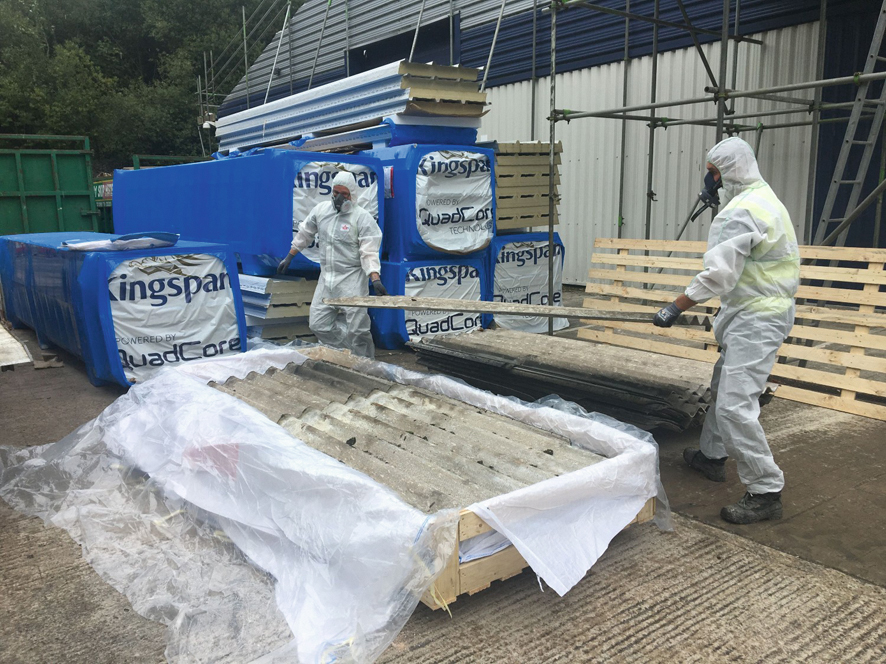
One of the biggest health & safety headaches for the construction industry is the ever-present risk of asbestos turning up, whether in a building under refurbishment or simply buried in a brownfield site.
Tonnes of the stuff – most of it in the form of asbestos-cement roofing or cladding sheets – still exist in buildings, just waiting to become somebody’s problem. And a problem it certainly is, with the cost of disposal, not to mention the disruption caused by its discovery, potentially impacting a construction project.
Wouldn’t it be great if, instead of being a troublesome (and potentially deadly) waste material, old asbestos-cement were a recyclable raw material for new products?
Well, now it is – at least in theory. Earlier this year, a new company called Thermal Recycling completed a demonstration project that successfully recycled asbestos-containing products into a safe material that can be used as a cement substitute.
Called Calmag, the recycled product is made from cement roof sheets containing chrysotile asbestos. Thermal treatment changes the chemical and physical composition of the asbestos, producing an asbestos-free material that is then crushed. The end product can be used as a sustainable aggregate and added to concrete mixes.
Supported by a government grant, Thermal Recycling opened its demonstration plant in Wolverhampton in September 2020. The aim was to prove that its technology could convert asbestos roofing on an industrial scale and in a commercially viable and environmentally safe way.
The project involved making prototype construction products from Calmag – named because it comprises calcium, aluminium and magnesium as silicates, carbonates, sulphates and oxides.
Independent laboratories then conducted extensive technical assessments of the product’s characteristics, including compression strength, load-bearing capability and water permeability. The research showed that Calmag is effective as a cement substitute.
READ MORE


Recent Comments