
Brief
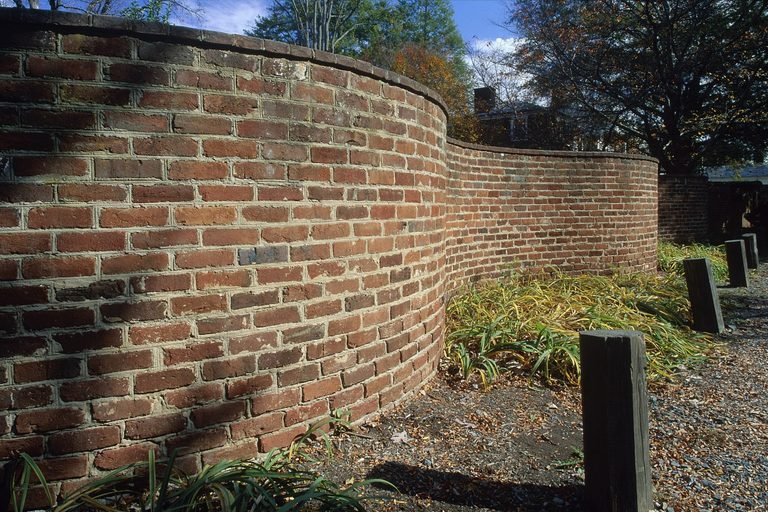
Every once in a while you might notice a brick wall that serpentines instead of cutting straight across. These so-called crinkle crankle walls are more common in England, but are found here and there in the U.S. as well. Their jump across the Atlantic is probably thanks to Thomas Jefferson, who directed them to be built at the University of Virginia (UVA) in the 1800s.
Insight
Thomas Jefferson was such a genius,” says Gary Porter, technical director at the Masonry Advisory Council. “Authorities at the time thought that Jefferson invented this design. However, he was merely adapting a well-established English style of construction.”It turns out the way Americans use a fork was also adapted from Europe.
What Are Those Wavy Brick Walls Called?
The term crinkle crankle walls probably came from the Old English word for zigzag. Sometimes they are also called ribbon, wavy, radius, serpentine, sinusoidal or crinkum crankum walls. The Dutch engineers who originally built them in England called them slang muur, which translates to snake wall.
Why Are They Wavy?
They serpentine for economy and strength, and likely also aesthetic reasons.A single row of bricks laid in a sine wave pattern is as strong or stronger than a standard straight wall and requires fewer bricks. (In the case of UVA’s walls, about 25 percent less.) That’s because straight walls need two rows of bricks and sometimes buttresses to survive over time, whereas wavy walls need just a single row.
“So it was more efficient, and that’s why they did it,” says Porter. “These walls actually act as an arch, and so that makes it strong for wind loads that might push on the wall. At the University of Virginia, that’s part of the story, but unfortunately not the whole story.
In 2018 UVA conducted a study about its historic ties to slavery. It discovered Jefferson also intended the eight-foot-tall walls to mask the use of slave labor on the campus. The walls physically and visually separated white students from the enslaved laborers, while keeping the enslaved from seeing beyond the walls. It also allowed slaveholders to more closely monitor the work being done by slaves.
READ MORE


Recent Comments