
Brief
Researchers in Germany are combining machine learning, structure modeling and imaging, and statistical methods to develop software that can sift through large quantities of CT image data from reinforced concrete beams and detect micrometer cracks. The researchers hope to expand on their work by eventually venturing into quantum computing to make the crack detection process faster.
Insight
oncrete’s properties as a material have made it an essential part of today’s construction methods. Alongside its many advantages, however, this universal favorite has its share of drawbacks—the most prominent being that its heterogeneous nature makes it difficult to dimension components and structures on the basis of simulations. Cracks induced by bending tests have provided some insights into component behavior.
Now, researchers at the Fraunhofer Institute for Industrial Mathematics ITWM are developing analysis software designed for computed tomography, with the aim of making it possible to see even the tiniest structural changes in reinforced concrete components. In the future the system will be able to evaluate several terabytes of CT image data—and quantum computing may come into play here too.
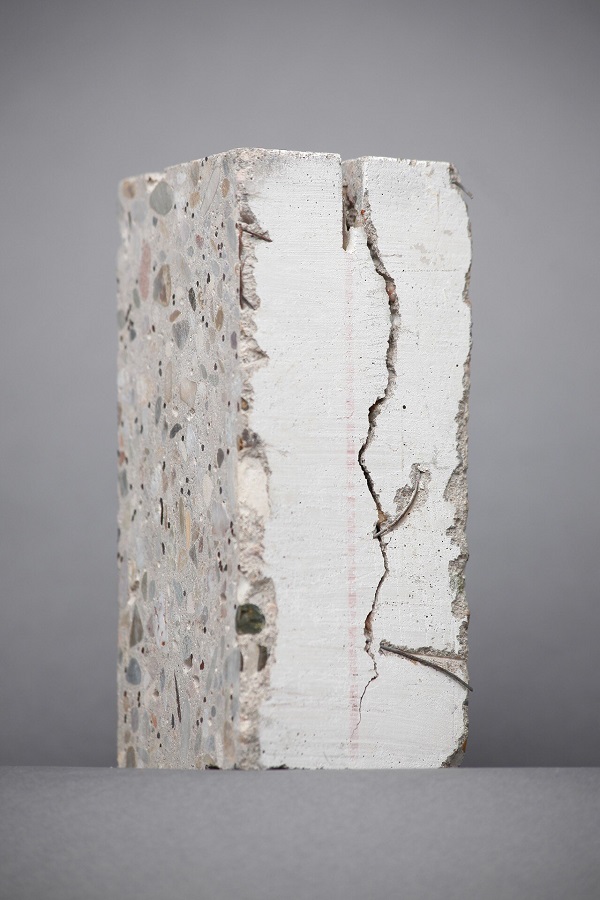
Computed tomography gives us a glimpse into inner worlds. It has become an essential tool in medical applications, used to perform routine investigations in the human body.
However, it also lends itself well to X-raying composite materials such as reinforced concrete and provides a non-destructive method of examining them. So what happens inside a concrete component when it is exposed to mechanical strain? Where do cracks occur? How are they created? And how do they grow as they are exposed to more and more strain?
These are the questions that the researchers at Fraunhofer ITWM are seeking to answer. In the BMBF-funded DAnoBi project on detecting anomalies in large-scale spatial image data, they are collaborating with working groups at the Technical University of Kaiserslautern, Ulm University and the University of Magdeburg with the aim of using robust, automation-friendly methods of finding crack structures in concrete on the basis of computed tomography data, fully segmenting these structures and recording them.
“Even in noisy CT data taken from small concrete samples, we have been able to not only detect cracks measuring mere micrometers, but also identify the voxels (data points on a three-dimensional grid) associated with them.


Recent Comments