
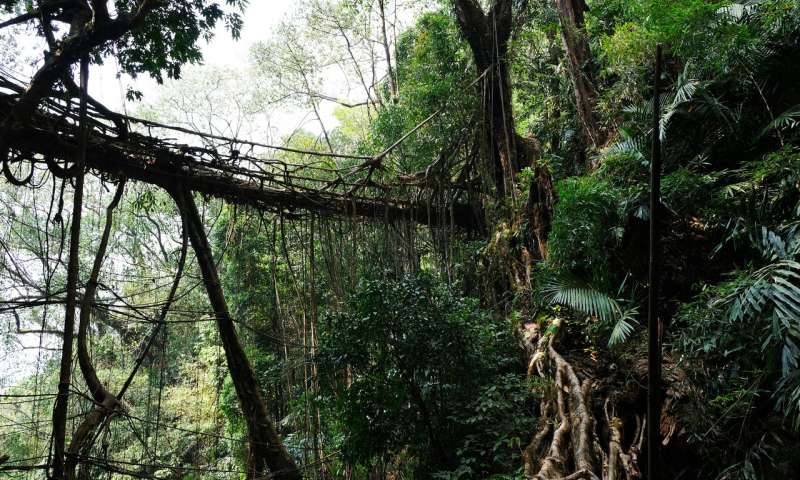
Dense, humid broadleaf forests, monsoon-swollen rivers and deep ravines—in the Indian state of Meghalaya wooden bridges easily decay or are washed away in floodwaters.
Bridges made from steel and concrete are pushed to their limits here as well. But bridges made of living tree roots can survive here for centuries. Prof. Ferdinand Ludwig of the Technical University of Munich (TUM) has investigated these special structures and proposes integrating this extraordinary building technique in modern architecture.
Inaccessible valleys and ravines lead from the North East India Meghalaya plateau to the wide plains of Bangladesh. In the monsoon months, the mountain streams in the forests swell into torrential rivers. In order to cross these rivers, the indigenous Khasi and Jaintia peoples have long built their bridges out of the living aerial roots of the Indian rubber tree Ficus elastica.
READ MORE


Recent Comments