
Brief
Learn about concrete curling causes, effects on slab performance, and practical strategies to minimise curling in concrete slabs.
Insight
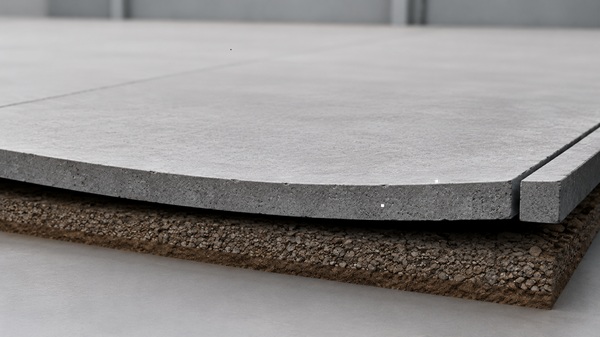
Concrete curling is a common form of deformation that affects concrete slabs-on-ground and can significantly influence long-term performance, serviceability, and durability. Curling occurs when a moisture or temperature gradient develops between the top and bottom surfaces of a concrete slab. As the upper surface dries and shrinks more rapidly than the lower surface, the slab edges and corners tend to lift upward, creating a concave-up shape. This phenomenon is particularly common in large industrial floors, warehouses, distribution centres, and other slab-on-ground applications.
Understanding concrete curling causes is essential for engineers, contractors, and concrete inspectors. Differential drying shrinkage is often the primary cause of curling in indoor facilities, while temperature variations may contribute to curling in both interior and exterior slabs. The resulting deformation can reduce floor flatness, increase joint deterioration, decrease aggregate interlock, and contribute to slab rocking under traffic loads. In severe cases, curling may reduce the effective load-carrying capacity of the slab and increase maintenance requirements.
Several factors influence the magnitude of concrete curling. These include slab thickness, joint spacing, concrete mixture properties, shrinkage characteristics, curing practices, environmental conditions, subgrade support, and the presence of a vapour barrier. Among these factors, joint spacing is often considered one of the most significant variables because larger panel sizes generally increase the potential for curling. Concrete strength development, creep behaviour, and the rate of moisture loss also play important roles in determining the final curl profile.
Modern concrete floor design increasingly recognises the importance of curling. Advanced finite element analysis (FEA) methods can incorporate curling effects during design, enabling more realistic slab thickness calculations and improved performance predictions. Accurate field measurements and long-term monitoring help designers develop more reliable design assumptions and optimise future projects.
To minimise curling, project teams should focus on appropriate concrete mix design, effective curing practices, suitable joint layouts, proper subgrade preparation, and careful control of moisture conditions. The use of vapour barriers, where appropriate, can also influence slab behaviour by reducing moisture migration from below. While curling cannot always be eliminated completely, understanding its mechanisms allows engineers to reduce its severity and improve slab performance.
For professionals involved in floor construction, learning about concrete slab performance, recognising the key concrete curling causes, and implementing suitable preventive measures are essential steps towards achieving durable and serviceable concrete floors.
Highlight
- Curling occurs when a moisture or temperature gradient develops between the top and bottom surfaces of a concrete slab. As the upper surface dries and shrinks more rapidly than the lower surface, the slab edges and corners tend to lift upward, creating a concave-up shape.
- crete curling. These include slab thickness, joint spacing, concrete mixture properties, shrinkage characteristics, curing practices, environmental conditions, subgrade support, and the presence of a vapour barrier.
- To minimise curling, project teams should focus on appropriate concrete mix design, effective curing practices, suitable joint layouts, proper subgrade preparation, and careful control of moisture conditions.
READ MORE
Related Questions:
Related Podcasts:
Related Publications:


Recent Comments