
Brief
Learn how the concrete soundness test identifies delamination and structural issues, helping inspectors make informed repair or replacement decisions.
Insight
Understanding the concrete soundness test is essential for assessing the integrity of in-place concrete, especially when determining whether slabs require repair, partial removal, or complete replacement. Soundness testing helps identify delamination, hollow zones, and areas where the concrete has lost its structural cohesion. These conditions often form through layer separation, creating voids that compromise durability. Using a soundness test on concrete allows inspectors to locate these weakened areas before planning repair works, ensuring a more efficient and cost-effective approach for both commercial and residential projects.
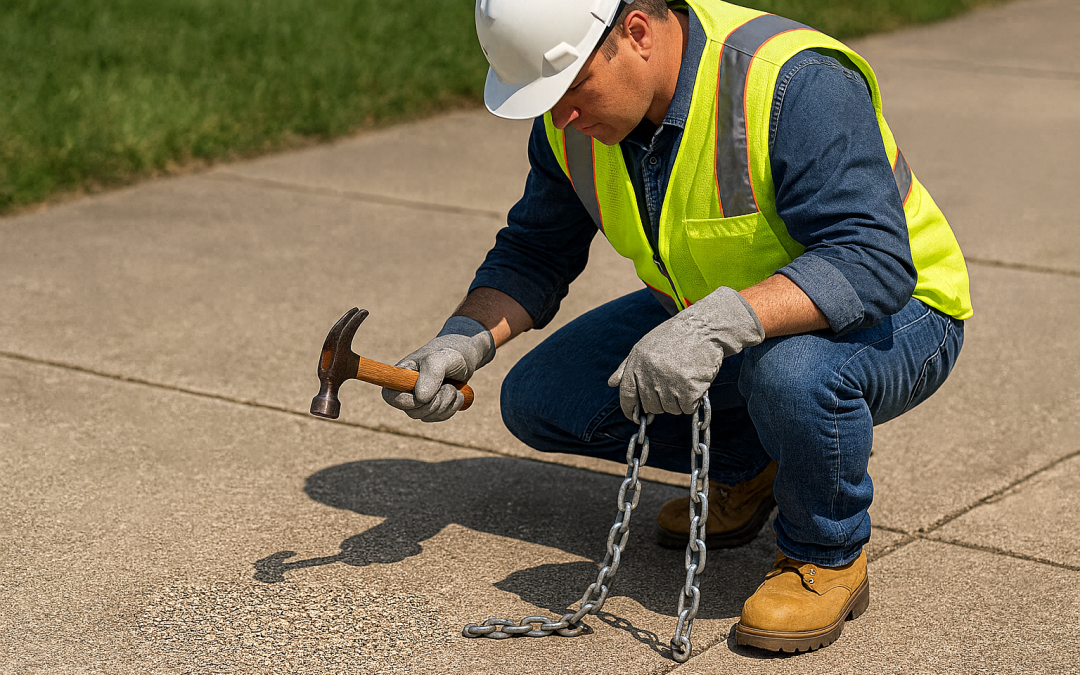
Traditional techniques such as chain dragging and hammer tapping remain widely relied upon due to their simplicity, reliability, and non-destructive nature. When a chain is dropped or dragged across the concrete surface, the sound it produces indicates the material’s condition. A clear ring typically signals solid concrete, while a dull thud or scraping noise suggests voids, delamination, or poor compaction. These results guide inspectors toward locations that require more detailed assessment or sectional removal. Hammer tapping further refines this process, helping pinpoint the exact boundaries of compromised concrete. These manual techniques are particularly effective for identifying issues within the upper few inches of a slab’s depth.
For projects requiring additional precision, more advanced non-invasive methods are available. Techniques such as impact echo, infrared thermography, and impulse response testing detect internal voids through stress waves, heat flow patterns, or structural vibration responses. While these methods offer enhanced accuracy, they require trained professionals and specialised equipment. They are often selected when concrete conditions are uncertain or when decisions regarding structural safety must be justified through detailed analysis.
Soundness testing also plays an important role in evaluating overlay bonding failures, surface capping issues, and areas influenced by subgrade settlement. By understanding the underlying causes of hollowness or delamination, project teams can choose appropriate remedial actions, ranging from surface repairs to full-depth removal. Applying the concrete soundness test early in the assessment process supports better decision-making and reduces unnecessary demolition. This approach promotes sustainability by avoiding excessive waste and extending the service life of concrete structures.
If you wish to explore structured training related to concrete evaluation, consider reviewing this industry-recognised certification programme for professional development. Incorporating the principles learned from soundness testing into daily practice ensures more reliable inspections and improved construction outcomes.
Highlight
- Using a soundness test on concrete allows inspectors to locate these weakened areas before planning repair works, ensuring a more efficient and cost-effective approach for both commercial and residential projects.
- When a chain is dropped or dragged across the concrete surface, the sound it produces indicates the material’s condition. A clear ring typically signals solid concrete, while a dull thud or scraping noise suggests voids, delamination, or poor compaction.
- Hammer tapping further refines this process, helping pinpoint the exact boundaries of compromised concrete. These manual techniques are particularly effective for identifying issues within the upper few inches of a slab’s depth.
READ MORE
Related Questions:
Related Publications:




Recent Comments