
Brief
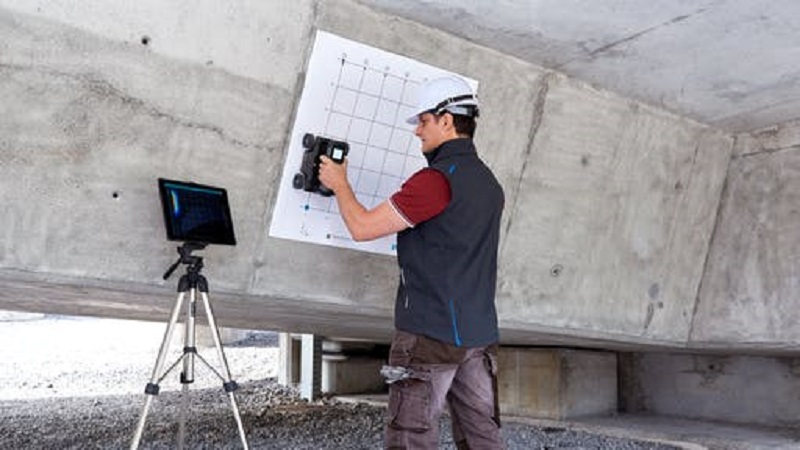
Michael Arvanitis from Screening Eagle Technologies examines the pros and cons of three common methods for detecting rebar — digital radiography, eddy current and ground penetrating radar — and the best applications for each approach. “Since there is no perfect solution, it is always advisable to apply more than a method on the field for best results,” Arvanitis writes.
Insight
Finding rebars inside concrete is vital for contractors, drillers, and construction engineers. Detecting the rebars’ position, including depth, is vital for many reasons; very often, there is the need to drill a hole in concrete without hitting the rebar, or you simply want to make sure that rebars exist, count their number and assess their condition. Measuring rebars is also performed for static calculations and to detect corrosion problems and damages.
Detection can be tricky, especially when you have multiple layers of rebars, young concrete or other elements inside. There are several methods available in the market each with its own pros and cons.
Eddy Current (EC) is a method using magnetic fields for detecting and measuring metallic objects. Transmitting coils in a probe are charged by current and thus generate a primary magnetic field. On the surface of metallic objects within the magnetic field, eddy currents are induced, which produce a secondary magnetic field in the opposite direction. The resulting change of voltage in the receiving coils can be utilized for measurement.
On the other hand, Ground Penetrating Radar (GPR) sends high-frequency electromagnetic waves down to the subsurface. The GPR calculates the time needed for a wave to travel down to a target and get back to the unit. This two-way traveltime gives the user a precise picture of the concrete subsurface, of foreign elements, like rebars and pipes. It is important to mention, that GPR compared to EC can detect both metallic and non-metallic targets.
READ MORE


Recent Comments